Trolling Motor Wiring & Diagrams
Table of Contents (Click to Jump To Section)
Introduction
Selecting and installing a trolling motor, especially for those unfamiliar with them, leads to a dizzying array of electrical questions ranging from wiring to proper battery type to motor run times. Understanding the wide range of electrical issues you'll come across is crucial in selecting the right motor for your needs.
If you've never purchased a new motor, you'll likely wonder what is included with the motor, and what additional components you'll need to get your motor up and running. When it comes to wiring and electrical issues, here's what will be included with a new trolling motor and what is not:
Included:
-
Positive and negative motor battery leads with “O” terminal endings
-
(For 24v & 36v Motors) Jumper extensions to wire additional batteries in series
Not Included:
-
12-volt Marine Battery(s)
-
Battery Charger
-
Circuit Breaker (optional)
-
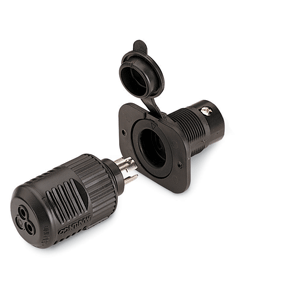
Trolling Motor Plug & Receptacle (optional)
We'll discuss each one of items mentioned in detail throughout this article.
There are two specific types of 12-volt batteries recommend for use with trolling motors: Deep Cycle Batteries & AGM Batteries. Due to shipping restrictions, we currently do not sell marine batteries at TrollingMotors.net. However, both types listed below should be widely available in most areas.
Deep Cycle Batteries – These batteries are specifically designed for the frequent draining and re-charging associated with trolling motor use, and are the most affordable option. They will last between one and two and a half years, can be purchased for less than $100 and are a standard lead-acid wet cell battery.
AGM Batteries – The other option is AGM Batteries, which stands for Absorbed Glass Mat. AGM Batteries are built differently than standard lead-acid deep cycle batteries and generally last longer on a charge and have a longer life-span as a result. While a traditional deep cycle battery might last approximately two years, an AGM battery will usually last between three to four years. AGMs cost significantly more than standard deep cycle batteries – usually twice as much – and may not be an option for those on a tight budget. While more expensive, they are the best choice for longevity and performance out on the water.
A common questions people have when trying to select a motor is “How long will this motor run out on the water?”. To answer this question, it's necessary to know two things: a battery's amperage hour rating and a motor's amperage draw.
Amperage Hour Rating: Marine batteries are rated on a metric called “amperage hours”, which is an indication of how long a battery can supply a consistent amperage. The larger the rating, the more power the battery can hold, and the longer it will be able to power a motor at a given speed. For example, a 100 amperage hour battery is one that would be able to supply 25 amps of power for 4 hours (25 amps * 4 hours = 100 amp hours) before running out of energy. Alternatively, the same battery could also supply 10 amps of power for 10 hours (10 amps * 10 hours = 100 amp hours) before running dry You can think of the amperage hour rating as being similar to a gas tank in a car – the larger it is, the more energy/fuel it can store, and the longer it can power a motor.
Motor Amperage Draw: The second factor we need to compute estimated run time is motor amperage draw. A motor's amperage draw rating refers to how much amperage (or current) a motor draws at a given speed. A motor's exact amperage draw rating isn't always easy to find, but should be available from the manufacturer or, if it's a motor we stock, from a TrollingMotors.net representative.
In order to approximate how long a certain motor will run on the water, you simply take the battery's amp hour rating and divide it by the amperage draw. For example, for a motor that pulls 20 amps at medium speed using a 100 amp hour battery, the run time would be:
100 amp hour rated battery / 20 amp draw = 5 hour run time
Most manufacturers will only list a motor's maximum amperage draw at top speed, so you may need to estimate other amperage draws at various speeds using the max speed amperage draw as a baseline.
For a general idea of approximate amperage draws by motor size, please see the chart below. Please note that these are approximations only and results will vary based on exact motor figures, batteries used and water conditions.

It's important to note that water and weather conditions can significantly affect battery performance. A motor drawing 20 amps to move a boat at medium speed in calm conditions may need 30 amps to move the same boat in strong wind or waves. If you plan on using your motor frequently in windy or stormy conditions, you'll want to factor this into your calculations.
There are a few things you can do to get the most run time possible from your battery & motor combination.
Use Variable Speed Motors: Using a variable speed motor (vs. a fixed speed motor) generally results in significantly longer run times. Variable motors are more expensive – generally about $100 more than a comparable fixed-speed model – but are more energy efficient, especially at slower speeds. They are also much more convenient as they allow you to dial in the speed to the exact setting you want vs. having to select from pre-set speeds.
Buy a Larger Motor: Larger 24v and 36v multi-battery trolling motors are able to provide the same thrust as smaller motors with less amperage draw, which results in longer run times. If you need seriously long run time for your smaller boat, it may make sense to buy a 24v or 36v motor.
Don't Fully Deplete Your Battery: It's never good for a battery to be run completely bone dry. Doing this on a regular basis will almost certainly reduce the lifespan of your battery. If possible, try to recharge your battery(s) before they are completely empty. Using a battery life indicator – a handheld unit or one built into the motor – will help you monitor battery life as well as reduce the chances of unexpectedly running our of power miles from shore.
Remember The Off-Season: It's really bad for batteries to be left uncharged for months at a time, and will contribute to shorter battery life and reduced performance. During the off-season, it's a good idea to use a battery tender or battery trickle charger which keep a small amount of current running through your batteries. Alternatively, you can also re-charge your batteries every month or so to ensure they retain a charge and don't sit empty. Both options will significantly increase the life of your batteries.
While not required for operation, circuit breakers are great insurance plans against destroying a motor. If a trolling motor prop is caught on an underwater object (rock,log,thick weeds, etc) and prevented from rotating, the motor will respond by using more and more power from the battery in an attempt to turn the shaft. If this goes on for two long, the high levels of current will permanently damage the motor's wiring, usually resulting in a completely totaled motor.
A trolling motor circuit breaker is designed to “trip” at a certain amperage, which breaks the circuit and prevents the motor from overloading and damaging itself. At between $20 and $40, they are significantly cheaper than purchasing a brand new motor! Circuit breakers come in varying amperages, and you want one that has an amperage rating (or amperage trip point) that is just above the amperage draw of your motor at max speed. If you're unsure of this figure, you should be safe going with a 60 amp breaker as this is higher than nearly all motor draws, and should be well below any damage causing levels.
24v Trolling Motor Wiring Diagrams
While small and medium trolling motors use a single 12v marine battery, larger trolling motors are often 24v and 36v systems, and require 2 or 3 marine batteries. These larger motors and multiple batteries are wired in a series pattern. The 24v trolling motor wiring diagram is listed below along with an optional circuit breaker:

The wiring diagram shown above displays the batteries wired in series, which doubles the voltage to 24v while keeping the amperage the same. A 36v trolling motor wiring diagram follows the same pattern with the third battery being installed between the two batteries seen in the 24v diagram. Following the same pattern, the positive terminal of the newly added middle battery would be attached to the negative terminal of battery #1, and it's negative terminal connected to the positive terminal of battery #3. This will provide 36v of voltage while keeping the amperage the same.
Trolling Motor Battery Chargers
After a long day on the water, you'll need to re-charge your batteries for the next outing. There are three different type marine battery charger options to select from for your trolling motor:
Portable AC Chargers: These are basic, AC powered, handheld chargers that are small, inexpensive and get the job done. They are usually connected to the batteries only when charging, and are removed and stored afterwards. These are great for small boat or kayak trolling motor use.
On-Board Battery Charger: Onboard battery chargers also require AC power but are permanently installed on the boat and wired into the battery system for convenient, one-plug charging. There's no need to mess around with alligator clips or deal with a loose charger. Instead, you simply plug your integrated charging system in a wall outlet and you're finished.
DC Alternator Chargers: DC alternator chargers are also permanently installed but are powered by the boat's engine alternator, and charge the battery anytime the motor is running. This can be extremely convenient when there won't be access to AC power for extended periods. However, depending on the number of batteries, it can take hours of motor run time to achieve a full charge. If you'll be returning most days to convenient AC power, standard on-board battery chargers are probably the best bet due to their faster charge times.
When picking a charger, you'll need to make sure to pick one with the proper number of banks. A charger's “banks” refers to how many batteries it can charge at any given time. A triple bank charger is able to charge 3 batteries at once, and therefore suitable for a 36v system. While there are numerous chargers on the market, Minn Kota Battery Chargers are trolling motor specific and very well-built. However, as long as your use a charger with the proper number of banks designed for 12-volt marine batteries you shouldn't have any problems.
It's also important to consider a charger's amperage rating, which indicates how quickly it can re-charge. The higher the rating, the faster it will re-charge batteries. Listed below is a rough estimation of how fast different amperage rated chargers can fully charge an empty, 12-volt battery:
Five Amp Charger – 8 to 10 Hours
Ten Amp Charger – 6 to 8 Hours
Fifteen Amp Charger – 4 to 6 Hours